Clinical placement service for Northern Kentucky University nursing studentsChat with the placement desk
NKU PreceptorsClinical placement for NKU nursing studentsFind my preceptor
Post-master's PMHNP

Psychiatric preceptors for NKU's post-master's PMHNP certificate

NKU's post-master's PMHNP certificate moves an MSN-prepared nurse into psychiatric-mental health practice with 35 credits and 750 clinical hours across MSN 664L, 665L, 667L, 668L and 669L. Each clinical is filed with NKU as a separate self-placement request in Medatrax. We find PMHNP and psychiatrist preceptors near you and plan the age mix across all five.

Plan your psychiatric clinicals

Tell us your state and when your first PMHNP clinical begins. A placement advisor maps preceptors across child, adult and older adult care.

By sending this you agree we may reply by email, call or text about your placement. Message and data rates may apply; reply STOP to opt out. Privacy

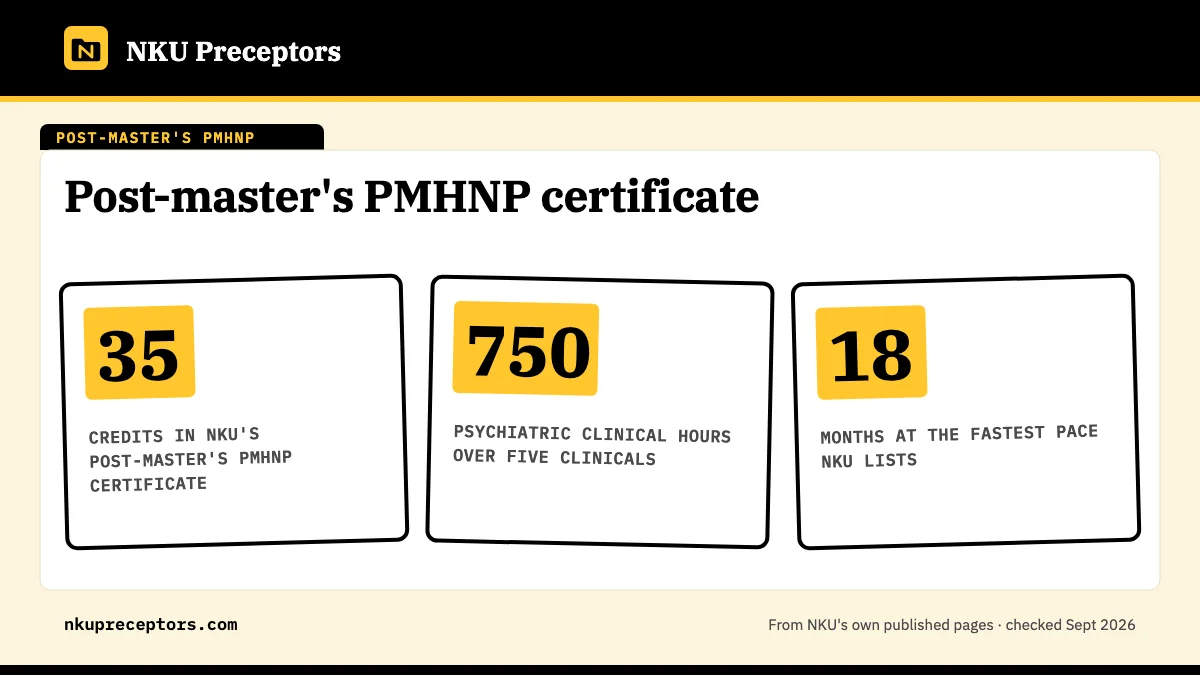
35credits in NKU's post-master's PMHNP certificate
750psychiatric clinical hours over five clinicals
18months at the fastest pace NKU lists
Post-master's PMHNP certificate. 35: credits in NKU's post-master's PMHNP certificate; 750: psychiatric clinical hours over five clinicals; 18: months at the fastest pace NKU lists.
35: credits in NKU's post-master's PMHNP certificate; 750: psychiatric clinical hours over five clinicals; 18: months at the fastest pace NKU lists.

Coursework and pace

NKU lists the certificate at 35 credits and a fastest pace of 18 months. It has three layers. The advanced practice core runs from MSN 609 to MSN 612. The psychiatric block covers psychopathopharmacology in two parts (MSN 671 and 672), assessment and diagnosis (673), psychotherapy (674) and disorder management (675), capped by the MSN 676 capstone. Five clinicals at 1 credit apiece hold the hours.

The design has changed. The 2023-24 catalog showed 34 credits and four clinicals, 664L, 665L, 667L and 668L. The 2025-26 catalog's PMHNP block states 750 required hours, and the 2024-25 catalog assigns 125 direct-care hours to MSN 669L. The other four clinicals carry no published per-course figure, and no NKU source lists a 666L. For the course-level view, see PMHNP clinicals.

Which certificate fits you

NKU runs two psychiatric certificates, and the choice turns on whether you already practice as an NP. The post-master's PMHNP asks for an MSN and an RN license, not an NP license, so it's the route for MSN-prepared nurses who don't yet hold NP credentials. If you already have an NP license and national certification, NKU's NP-to-PMHNP certificate is the shorter path at 20 credits.

Admission here asks for an MSN earned in an ACEN, CCNE or CNEA accredited program, a 3.0 GPA in that MSN, an RN license with no encumbrance, 1,000 hours of RN clinical work and a PreCheck background check. No psychiatric background is listed today, although the 2023-24 catalog once required 2,000 psychiatric RN hours. NKU may compare your earlier core syllabi with its own and add any course that didn't span the lifespan.

Who can precept, and the 80-hour rule

Two credentials qualify as your main preceptor: either a PMHNP or a psychiatrist, with graduate training and a year or more in practice. Care settings include psych and mental health facilities, outpatient clinics, treatment programs and hospital inpatient units. Therapy and counseling time may be supervised by a psychologist, an LICSW or an LPCC, capped at 80 hours for the whole certificate.

Every preceptor must also

  • Have at least one year behind them in their current role and degree
  • Hold a license with no restrictions, in a state NKU accepts
  • Work at the site where you train, below NKU's per-preceptor student cap
  • Sit outside your family, friendships, household and reporting line

NKU's setting rules page sets the 80-hour counseling cap beside the caps for the other tracks.

Planning the age spread

NKU frames every PMHNP clinical as lifespan care. Its FAQ suggests roughly 170 hours with pediatric patients and 165 each with adults and geriatric clients, and ties ANCC certification to having hours in all three groups. Those three figures add to 500, carried over from the older program, so use them as a sense of proportion within 750 rather than a quota.

With one clinical per 7-week session, the spread comes from deliberate choices: a youth psychiatric clinic in one session, adult outpatient or inpatient care in the next, and a service with many older patients later on. Record the age group behind your hours as you log them, so MSN 669L, the last clinical, isn't left to fill a gap.

Fitting clinicals around work

NKU asks preceptors for two or three days a week across a 7-week rotation of roughly 125 to 150 hours, and those days have to be yours as well. If you work full time, settle the schedule with your employer before the session opens, and choose preceptors whose clinic days match the time you can clear. Five rotations means five rounds of that conversation, so plan the whole year at once.

Your current employer can host clinicals if you train outside your own unit or patient-care area, with a preceptor who isn't your immediate supervisor, during hours you aren't paid for. A behavioral health service elsewhere in your own system can meet all three. The employer sites page walks through each condition.

States and each request

NKU accepts applicants to this certificate only from Colorado, Florida, Georgia, Illinois, Indiana, Kentucky, Michigan, Nevada, Ohio, Virginia and West Virginia. Each preceptor must also be practicing in a state on NKU's approved list, and relocating during the certificate can affect your standing. NP admission states tracks how the list has changed since Spring 2023.

Each clinical goes to NKU as a self-placement request in Medatrax, due 30 days before the session at the latest and ideally 90. The psychiatric preceptor sends in a resume and license, signs the Preceptor Responsibilities form and sets up a Medatrax profile. A practice that has never hosted an NKU student may need an affiliation agreement, so you pass NKU a contact there early.

Why PMHNP certificate students choose us

We find psychiatric preceptors with the age mix already mapped. A placement advisor locates PMHNPs and psychiatrists near you, assigns rotations so pediatric, adult and geriatric patients all get real time, and fits any therapy supervision inside the 80-hour cap. We also look at each practice's clinic days, so your rotations fit the schedule you actually have.

We screen each preceptor for NKU's credential, experience, license and state requirements before any introduction, and every request arrives at NKU complete and early. NKU approves each placement; our work is making sure its reviewers find nothing missing. If a practice's schedule changes partway through, a replacement is lined up quickly. Read how it works for the full sequence.

FAQ

Questions NKU nursing students ask

Should I choose NKU's post-master's PMHNP or its NP-to-PMHNP?

The post-master's PMHNP (35 credits, as few as 18 months) needs an MSN and an RN license and includes the advanced practice core. The NP-to-PMHNP (20 credits, as few as 14 months) is for licensed, nationally certified NPs and starts with the psychiatric courses. Both carry 750 clinical hours in the same five clinicals.

Can a psychologist precept my NKU PMHNP hours?

Only for therapy or counseling experiences, and only up to 80 hours over the certificate. Psychologists, LICSWs and LPCCs fit that role. Every other hour needs a PMHNP or a psychiatrist who meets NKU's year-in-role, license, state and site rules.

How many clinicals are in the NKU post-master's PMHNP?

Five: MSN 664L, 665L, 667L, 668L and 669L, totaling 750 hours. There is no 666L. The 2023-24 catalog had four clinicals, which is why some older NKU pages still describe four residencies for the psychiatric track. Plan five preceptor placements, one per 7-week session.

Do I need psychiatric experience for the post-master's PMHNP?

Not today. Current admission requirements list an MSN from an accredited program (3.0 GPA), an RN license in good standing, 1,000 clinical practice hours as an RN and a background check. The 2023-24 catalog did ask for 2,000 hours in a psychiatric setting; that line is gone from the current requirements.

How early should I line up PMHNP certificate preceptors?

NKU highly recommends getting preceptor information in 90 days before each clinical and treats 30 days as the floor. For a Spring 2 2027 clinical starting March 15, the 90-day point falls in mid-December 2026 by our count. With five clinicals in a row, mapping the whole run at once keeps every deadline in view.

Can I do PMHNP clinical hours through telehealth at NKU?

No public NKU page addresses whether telehealth visits count toward psychiatric clinical hours. Raise it with the Clinical Instructor for your course before a rotation relies on virtual care, and save the reply alongside your time logs. Our virtual clinical options page suggests what to ask.

Last checked 2026-09-24

We check these pages against NKU's own published sources. NKU's School of Nursing and your Canvas clinical shells have the final word.

Placement desk

Your NKU preceptor, found and filed early.

Tell us your NKU track, where you live and which 7-week session your clinical starts. We find a preceptor and site that fit NKU's rules for your track and have your self-placement request ready well inside the 90-day window.

  • Built for FNP, AGACNP, PMHNP, Nursing Education, Leadership and DNP students
  • Preceptor CV, license and responsibilities form gathered for Medatrax
  • Near home, in a state NKU approves

Start your placement plan

A placement advisor replies with the preceptor and site that fit NKU's rules for you.

By sending this you agree we may reply by email, call or text about your placement. Message and data rates may apply; reply STOP to opt out. Privacy

Placement deskPlacement Coordinator · online