Clinical placement service for Northern Kentucky University nursing studentsChat with the placement desk
NKU PreceptorsClinical placement for NKU nursing studentsFind my preceptor
Your employer as a site

Doing NKU clinical hours at the hospital or practice where you work

NKU allows clinicals at your current employer, with three conditions. You train away from your own unit and patient-care area, someone other than your immediate supervisor precepts you, and not one clinical hour falls in time you are paid as an employee.

Get your placement plan

Tell us your NKU track and where you live. A placement advisor replies with the preceptor and site that fit NKU's rules for you.

By sending this you agree we may reply by email, call or text about your placement. Message and data rates may apply; reply STOP to opt out. Privacy

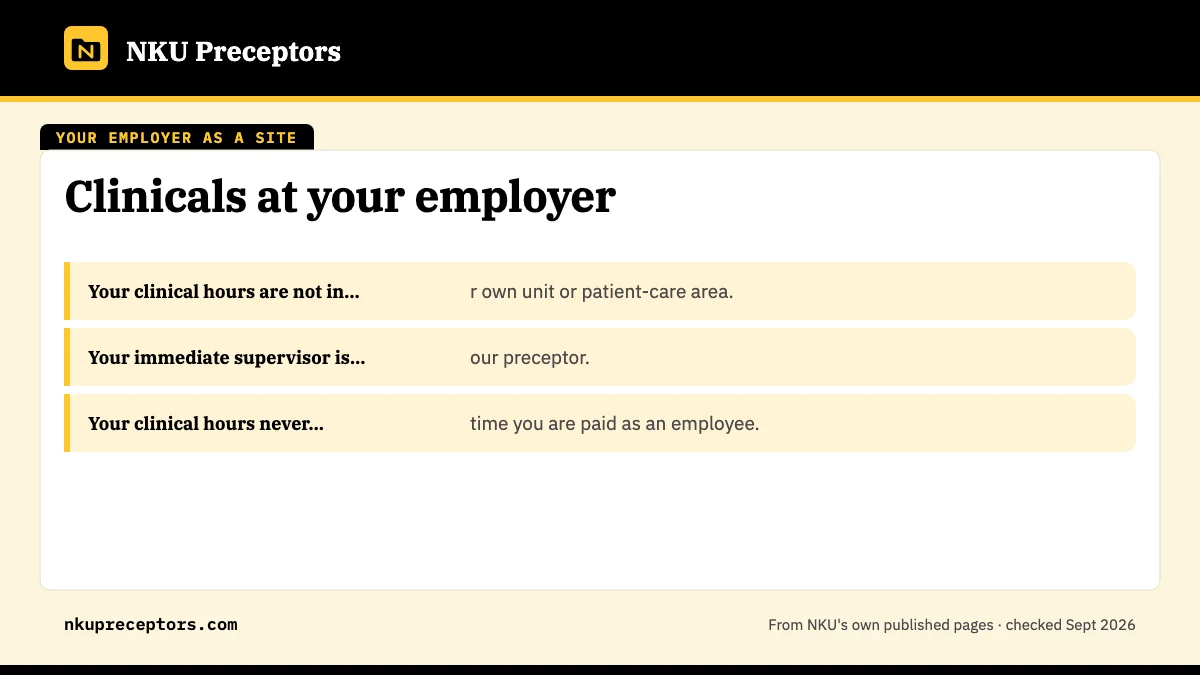
NKU's answer: yes, with three conditions: Your clinical hours are not in your own unit or patient-care; Your immediate supervisor is not your preceptor.; Your clinical hours never overlap time you are paid as an em.

NKU's answer: yes, with three conditions

NKU's online FAQ asks the question directly: can students do clinicals at their current place of employment? The answer is yes, with three rules, and the answer names no exception for any track from FNP to Nurse Executive Leadership.

The three conditions

  • Your clinical hours are not in your own unit or patient-care area.
  • Your immediate supervisor is not your preceptor.
  • Your clinical hours never overlap time you are paid as an employee.

NKU's preceptor requirements page backs up the second rule from the preceptor side, barring anyone who is the student's "direct or immediate supervisor" from precepting. The same page adds that the preceptor must be employed at the location where the practicum takes place, which an employer rotation usually meets without effort.

An employer site still goes through the same Medatrax self-placement request as any other site. Working there does not skip the coordinator review or the Contracts & Compliance check.

A different unit or patient area

The first condition keeps the student role separate from the job. If you work in an emergency department, an AGACNP rotation in the same hospital's ICU is on a different unit. If you work inpatient, an FNP rotation in your health system's primary care office is a different patient-care area.

Some roles blur the line. Float pool nurses, house supervisors and nurses who cover several clinics may not have a single home unit. NKU does not define the boundary for these roles, so describe your job plainly to your Clinical Coordinator and get a clear answer before the request goes in.

The setting still has to fit your track. An employer rotation in urgent care draws on the FNP specialty allowance, and an ED rotation counts toward the AGACNP emergency limit; our setting rules page lists those caps.

A preceptor outside your reporting line

Your preceptor cannot be anyone you report to. NKU's list of barred relationships also covers relatives, significant others, roommates, personal friends and your own primary care provider, and a colleague you are close with away from work may fall under the personal-friend rule. Say so up front rather than leave it for a reviewer to discover.

The standard preceptor rules still apply: a year or more in their present role at their present degree level, a license that is active with no encumbrance, practice in a state NKU approves, and capacity under NKU's student-ratio cap. Our preceptor requirements page has the credential list by track.

Nurse Executive Leadership students need extra care here. Your MSN 631L preceptor is an MSN-prepared nurse leader at manager level or above, and in your own organization that person is often in your chain of command. Look for a leader in a different department or division.

Unpaid hours on your own schedule

The third condition shapes your calendar. Each NKU rotation packs roughly 125 to 150 hours into seven weeks, with preceptors asked to be available two or three days in each of them. None of those hours can be paid time, so plan days off, schedule changes or unpaid leave before the session starts.

Keep the two roles visibly separate. Clinical hours go into your Medatrax time log for the preceptor to verify each week, and paid shifts stay on your employer's timekeeping. If a manager asks you to work a paid shift on a clinical day, those paid hours cannot also count as clinical hours.

A clean record protects you later. Verified Medatrax entries cannot be edited, so log accurately the first time; our hour logs guide explains the weekly verification.

Paperwork when the site is your employer

The file is the same as for any site: the preceptor's CV or resume and license, the signed Preceptor Responsibilities form, a Medatrax Preceptor Profile, and your self-placement request. The difference is the contract.

If your employer already holds an affiliation agreement with NKU, the contract portion has a head start. If it does not, you give NKU a contact person at the organization and NKU negotiates the agreement, which must be final before the clinical term. NKU warns that a new negotiation may not finish before class starts, so ask early whether an agreement exists. Our affiliation agreements guide covers the details.

Coming back to the same employer for a later course still means a fresh self-placement request for that rotation. An agreement already in place helps, but the preceptor review and compliance check run again for each request.

When the employer route is the right one

Your employer can be the fastest path when it has an NKU agreement, a qualified preceptor on another unit and a manager willing to adjust your paid schedule. You already know who to ask, and the commute is settled.

It is a harder path when every qualified preceptor sits in your reporting line, when your role has no clear home unit, or when your paid schedule cannot flex to two or three clinical days a week. In those cases an outside site is often the simpler route.

Before you approach a preceptor at work, ask your manager two questions: can your paid schedule flex for the full seven weeks, and does the organization already host NKU students? Two clear answers tell you which route to take.

How we set up employer rotations

When your employer is a good fit, a placement advisor helps you identify an eligible preceptor on another unit, confirms the three conditions in writing, and gathers the preceptor file and the site contact for the agreement. When it is not, we move straight to track-matched preceptors at outside sites near your home in an NKU-approved state.

Either way, your Medatrax request goes in complete. NKU makes the approval decision, and the placement reaching its reviewers already meets the employer rules. If an employer preceptor withdraws partway through, we start the replacement search right away. Tell us where you work and your next L course with the form below, or visit our contact page.

FAQ

Questions NKU nursing students ask

Can I do NKU clinical hours at my own job?

Yes. NKU's online FAQ permits clinicals where you already work, provided you train on a different unit and patient-care area from your job, a person other than your immediate supervisor precepts you, and no clinical hour overlaps paid time. The placement still needs a Medatrax self-placement request and full NKU review.

Can my manager or medical director be my preceptor?

Not if they are your direct or immediate supervisor; NKU bars that relationship. Someone outside your reporting line can qualify if they meet the track's credential rules and the one-year-in-role rule. If the reporting line is unclear, such as a medical director who oversees your unit, explain it to your Clinical Coordinator before you submit.

Can I count clinical hours during a paid shift if the work is different?

No. NKU's condition is about pay, not the type of work. Any hour you are paid for as an employee cannot also be a clinical hour, even on another unit with a different preceptor. Schedule clinical days as unpaid time and keep your Medatrax time log separate from your employer's timekeeping.

Does working at the site make NKU approval faster?

Sometimes. If your employer already holds an NKU affiliation agreement, the contract portion has less to do. The coordinator still reviews your preceptor and Contracts & Compliance still checks your compliance record, and a site with no agreement needs NKU to negotiate one before the term, which can take time.

I work in a float pool. Which unit counts as my own?

NKU's FAQ does not define it for float or multi-unit roles. Describe exactly where you work and which units you cover to your Clinical Coordinator, and ask which areas are open for clinical hours. Get the answer in writing, then choose a preceptor in an area you never staff.

Last checked 2026-09-24

We check these pages against NKU's own published sources. NKU's School of Nursing and your Canvas clinical shells have the final word.

Placement desk

Your NKU preceptor, found and filed early.

Tell us your NKU track, where you live and which 7-week session your clinical starts. We find a preceptor and site that fit NKU's rules for your track and have your self-placement request ready well inside the 90-day window.

  • Built for FNP, AGACNP, PMHNP, Nursing Education, Leadership and DNP students
  • Preceptor CV, license and responsibilities form gathered for Medatrax
  • Near home, in a state NKU approves

Start your placement plan

A placement advisor replies with the preceptor and site that fit NKU's rules for you.

By sending this you agree we may reply by email, call or text about your placement. Message and data rates may apply; reply STOP to opt out. Privacy

Placement deskPlacement Coordinator · online