Clinical placement service for Northern Kentucky University nursing studentsChat with the placement desk
NKU PreceptorsClinical placement for NKU nursing studentsFind my preceptor
Setting rules

Where NKU lets you spend clinical hours, track by track

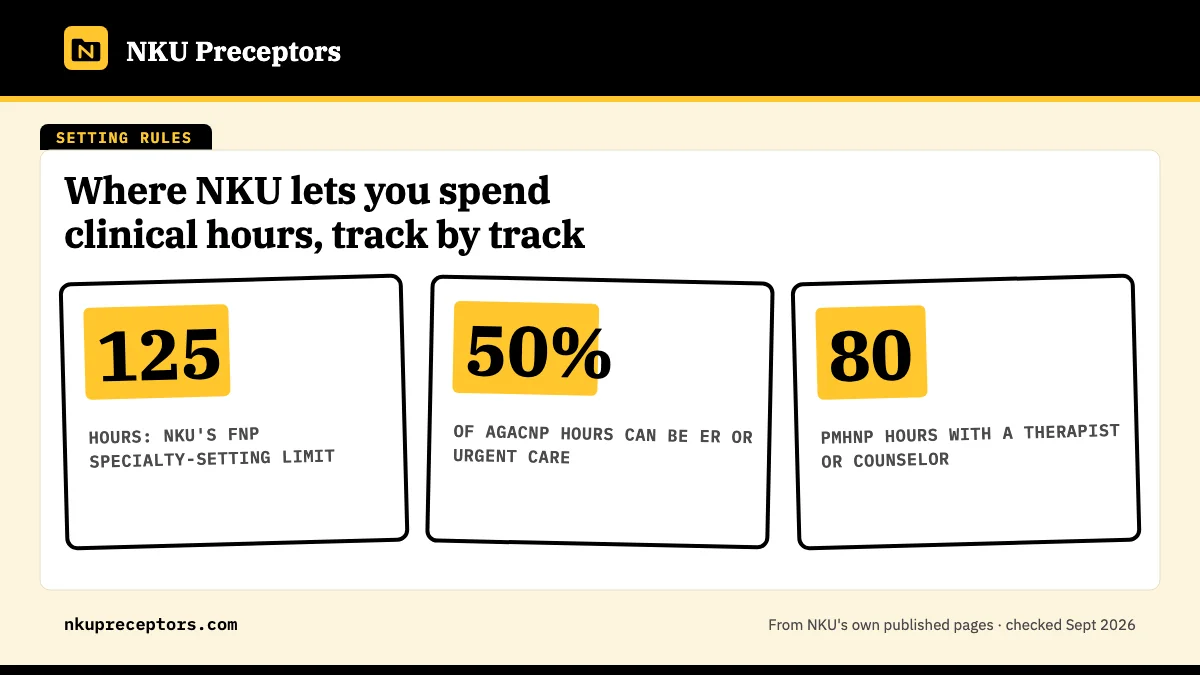
Every NKU track names the settings it expects, and three NP tracks put a ceiling on side settings: 125 FNP specialty hours, half of AGACNP hours in the ER or urgent care, and 80 PMHNP therapy hours. Check the setting against these limits before a preceptor signs anything.

Get your placement plan

Tell us your NKU track and where you live. A placement advisor replies with the preceptor and site that fit NKU's rules for you.

By sending this you agree we may reply by email, call or text about your placement. Message and data rates may apply; reply STOP to opt out. Privacy

125hours: NKU's FNP specialty-setting limit
50%of AGACNP hours can be ER or urgent care
80PMHNP hours with a therapist or counselor
Where NKU lets you spend clinical hours, track by track. 125: hours: NKU's FNP specialty-setting limit; 50%: of AGACNP hours can be ER or urgent care; 80: PMHNP hours with a therapist or counselor.
125: hours: NKU's FNP specialty-setting limit; 50%: of AGACNP hours can be ER or urgent care; 80: PMHNP hours with a therapist or counselor.

The setting limits in one table

NKU's online FAQ lists expected sites for each concentration under its preceptor qualifications answer. The table puts the settings and the limits side by side. Who may precept in each setting is a separate question, answered on our preceptor requirements page.

Settings and limits by NKU track (NKU online FAQ and program pages)
TrackMain settingsLimit or condition
FNPPrimary care clinics and physician offices; long-term care; hospiceSpecialty offices such as urgent care or cardiology up to 125 hours
AGACNPAcute care hospitalsER and urgent care for up to 50% of hours
PMHNPPsychiatric and mental health facilities, outpatient clinics and treatment centers, inpatient hospital unitsTherapy with a psychologist, LICSW or LPCC up to 80 hours over the program
Nursing EducationA school of nursing or a healthcare facility's education department50 direct-care hours for MSN 614L; 150 capstone hours for MSN 670
Nurse Executive LeadershipA hospital, or another setting the NEL coordinator approves100 hours for MSN 631L with a nurse leader at manager level or above

FNP: primary care first

FNP hours belong mainly in primary care: clinics, physician offices, long-term care and hospice all appear on NKU's list. Specialty offices are allowed in measure. The FAQ names urgent care and cardiology as examples and caps specialty time at 125 hours.

NKU words the cap two ways. The concentration answer says specialty offices may be used for up to 125 hours, while a general line says specialty settings "should be limited to up to 125 hours per specialty rotation." If you plan more than one specialty stint across MSN 650L to MSN 655L, ask your Clinical Coordinator which reading applies before you commit.

Urgent care is the setting most easily misfiled. The patients can look like a primary care panel, but NKU places urgent care with the specialty offices, so those hours draw on the same 125-hour allowance.

AGACNP: acute care with an ER ceiling

AGACNP rotations belong in acute care hospitals. Emergency departments and urgent care count, but NKU's FAQ limits them to up to 50% of your hours. NKU does not say whether the half is measured per rotation or across all 750 hours; across the program it would be 375 hours by our arithmetic.

The later residencies lean harder into acuity. NKU's program page steers Clinical Courses IV and V toward high-acuity and specialty areas, and the 2024-25 catalog sets 150 hours of direct patient care for each of MSN 659L, MSN 661L, MSN 662L and MSN 663L.

A preceptor who splits time between an ICU and an ED can work well, provided the hours logged in each setting are tracked from the first week. Our AGACNP clinicals guide maps the five courses.

PMHNP: therapy hours and the age spread

PMHNP students rotate through inpatient hospital units, outpatient clinics and treatment centers, or dedicated psychiatric and mental health facilities, with a PMHNP or psychiatrist precepting. Therapy experiences with a psychologist, LICSW or LPCC count too, capped at 80 hours for the entire program.

The age spread needs early planning. NKU's FAQ recommends 170 pediatric, 165 adult and 165 geriatric hours. Those figures add up to 500, the older program total, while the current program pages list 750, so treat them as a guide to balance rather than a quota. NKU calls them recommendations but says hours in every age group are needed for ANCC certification.

A site that sees only adults cannot carry all five courses. Plan where pediatric and geriatric hours will come from before MSN 664L begins; the PMHNP clinicals page lays out the sequence.

Nursing Education and Nurse Executive

Nursing Education has two clinical pieces. MSN 614L needs 50 direct patient-care hours with a preceptor; NKU's FAQ gives wound care, clinics, acute care units, nurse midwives, outpatient and surgery centers and the PACU as examples. The MSN 670 capstone happens in an educational setting with a preceptor who works as an educator. The program page lists 150 capstone hours, while the FAQ says about 100 to 150.

Nurse Executive Leadership students spend 100 hours in MSN 631L with an MSN-prepared nurse leader at nurse manager level or above. NKU names a hospital as the usual setting, and the NEL coordinator can approve others. NKU's FAQ describes shadowing, meetings or a small capstone project as typical activities.

What NKU leaves open

Some limits students expect are not in NKU's published rules. NKU publishes no cap on the share of hours spent with MD, DO or PA preceptors, though NKU accepts PAs only where the state allows them to precept. NKU publishes no telehealth rule either; our virtual clinical options page lists the questions to put to your coordinator.

You may work with one to four preceptors across the MSN, according to the FAQ, and weekly minimum and maximum hours vary by course and sit in the syllabus. Track totals and the older 500 to 600 hour wording are covered on our clinical hours page.

Matching the site to the limit

A placement advisor starts with your track's limits, not just an open schedule. For FNP students we look for primary care first and use specialty time deliberately; for AGACNP students we confirm how a preceptor's ED shifts fit the 50% line; for PMHNP students we plan the age spread across all five courses. If a rotation ends up heavier in one setting than planned, the next match is chosen to rebalance it.

Each match arrives with the preceptor's documents gathered and a named site contact, ready for your Medatrax request. NKU makes the final call, and we make sure the setting you submit already fits its rules. Tell us your track and next L course with the form below.

FAQ

Questions NKU nursing students ask

Can NKU FNP students do clinical hours in urgent care?

Yes, within limits. NKU's online FAQ lists urgent care with cardiology and similar practices as specialty offices, and specialty time is capped at 125 hours. Primary care clinics, physician offices, long-term care and hospice carry the rest of your FNP hours. Ask your Clinical Coordinator how the cap applies if you plan specialty time in more than one course.

Is the AGACNP emergency department limit per course or for the whole program?

NKU's FAQ says ER and urgent care may be used for up to 50% of hours and does not say which total it means. The safe plan is to keep each rotation mostly in inpatient acute care and confirm the reading with your AGACNP Clinical Coordinator before a preceptor with heavy ED shifts is submitted in Medatrax.

Do NKU PMHNP students need pediatric hours?

NKU suggests 170 hours with children and adolescents, 165 with adults and 165 with older adults, and says experience with every age group is needed for ANCC certification. The split is framed as advice, and the numbers were set when the program required 500 hours. Plan at least one rotation where children and adolescents are a real part of the caseload.

Can a licensed clinical social worker supervise PMHNP therapy hours?

NKU's list names a psychologist, an LICSW or an LPCC for psychotherapy and counseling experiences, capped at 80 hours over the program. Licensing titles vary by state, so if your therapist holds a differently named license, ask your PMHNP Clinical Coordinator whether it matches NKU's list before logging hours.

Is there a limit on hours with physician or PA preceptors?

NKU publishes no cap on the share of hours with MD, DO or PA preceptors. NKU lists which provider types each track accepts, and PAs qualify only where the state allows them to precept. The caps NKU does publish are the FNP specialty limit, the AGACNP ER limit and the PMHNP therapy limit.

Last checked 2026-09-24

We check these pages against NKU's own published sources. NKU's School of Nursing and your Canvas clinical shells have the final word.

Placement desk

Your NKU preceptor, found and filed early.

Tell us your NKU track, where you live and which 7-week session your clinical starts. We find a preceptor and site that fit NKU's rules for your track and have your self-placement request ready well inside the 90-day window.

  • Built for FNP, AGACNP, PMHNP, Nursing Education, Leadership and DNP students
  • Preceptor CV, license and responsibilities form gathered for Medatrax
  • Near home, in a state NKU approves

Start your placement plan

A placement advisor replies with the preceptor and site that fit NKU's rules for you.

By sending this you agree we may reply by email, call or text about your placement. Message and data rates may apply; reply STOP to opt out. Privacy

Placement deskPlacement Coordinator · online