Clinical placement service for Northern Kentucky University nursing studentsChat with the placement desk
NKU PreceptorsClinical placement for NKU nursing studentsFind my preceptor
Clinical hour logs

Logging NKU clinical hours, from the first shift to the hours letter

You record clinical hours in your Medatrax time log, and your preceptor verifies them every week. Once an entry is verified it cannot be edited, so accuracy comes before speed. After graduation, the School of Nursing certifies clinical hours through its graduate form requests.

Get your placement plan

Tell us your NKU track and where you live. A placement advisor replies with the preceptor and site that fit NKU's rules for you.

By sending this you agree we may reply by email, call or text about your placement. Message and data rates may apply; reply STOP to opt out. Privacy

750clinical hours in each NKU NP track today
1,000post-baccalaureate hours NKU's DNP requires
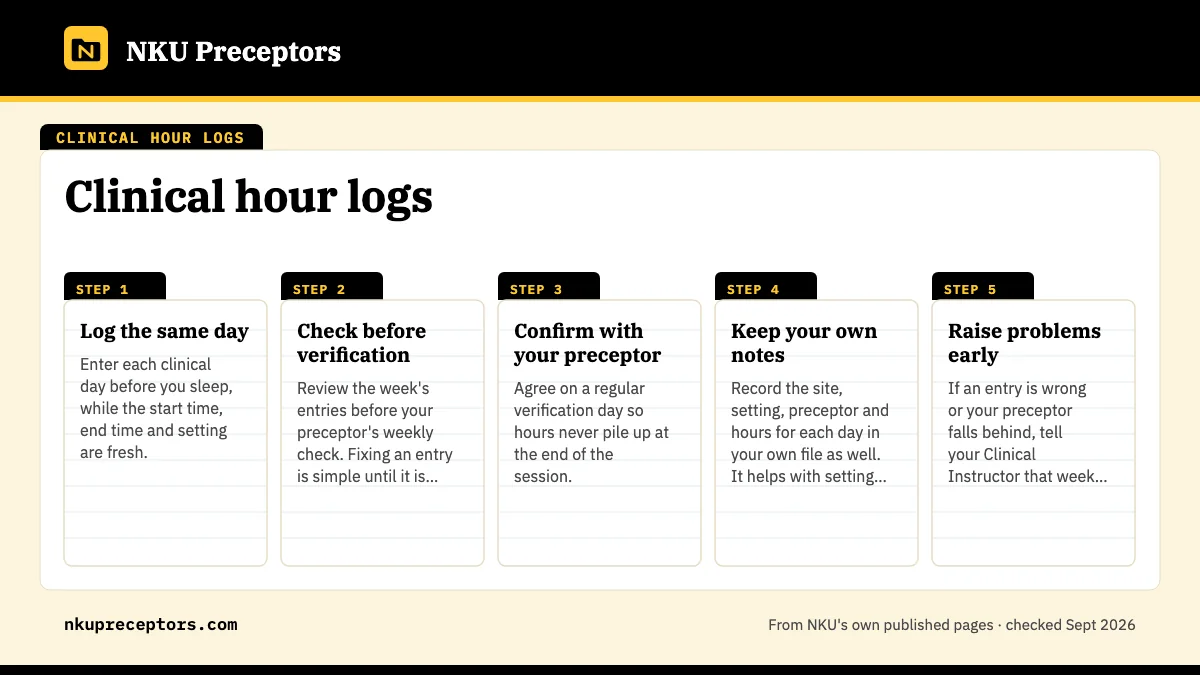
Numbered steps. A weekly routine that keeps logs clean: 1 Log the same day; 2 Check before verification; 3 Confirm with your preceptor; 4 Keep your own notes; 5 Raise problems early.
A weekly routine that keeps logs clean: 1 Log the same day; 2 Check before verification; 3 Confirm with your preceptor; 4 Keep your own notes; 5 Raise problems early.

How hour logging works at NKU

NKU's online FAQ puts it simply: hours are tracked in Medatrax, NKU's clinical management system. You enter each clinical day in your time log, and your preceptor reviews and verifies the entries in Medatrax.

NKU's preceptor readiness checklist sets the rhythm as weekly verification, and NKU's Current Preceptors page and its time-log guide for preceptors add the rule that matters most to you: once your preceptor verifies an entry, it can no longer be edited.

That lock is what makes NKU's hour records trustworthy for certification boards and later programs. It also means a careless entry can follow you into later applications, so treat the time log as a clinical document rather than a timesheet.

A weekly routine that keeps logs clean

  1. Log the same dayEnter each clinical day before you sleep, while the start time, end time and setting are fresh.
  2. Check before verificationReview the week's entries before your preceptor's weekly check. Fixing an entry is simple until it is verified.
  3. Confirm with your preceptorAgree on a regular verification day so hours never pile up at the end of the session.
  4. Keep your own notesRecord the site, setting, preceptor and hours for each day in your own file as well. It helps with setting caps and later certification.
  5. Raise problems earlyIf an entry is wrong or your preceptor falls behind, tell your Clinical Instructor that week, not in week seven.

Pacing hours across seven weeks

A single rotation carries about 125 to 150 hours by NKU's estimate, worked on two or three days a week across seven weeks. Our arithmetic puts that at 18 to 21 hours in a typical week. NKU's FAQ adds that weekly minimum and maximum hours vary by course and are set in the syllabus, so check yours before week one.

Some hours also need tracking by setting. FNP specialty time is capped at 125 hours, AGACNP emergency and urgent care time at half of hours, and PMHNP therapy time at 80 hours over the program, with NKU recommending hours across pediatric, adult and geriatric patients. Our setting rules page has the details. Logging the setting with every entry makes those limits easy to prove.

Paid employee time never doubles as clinical time, including at an employer that also hosts your rotation. Our employer clinicals page covers that rule.

Why verification matters to your preceptor

Weekly verification protects your preceptor as well as you. NKU's preceptor pages have told preceptors to verify all of a student's hours before their professional development provision is paid, and payment is issued only after the term ends. A preceptor who verifies each week is not left with a backlog when the term closes.

The same verified hours become the preceptor's record. NKU's end-of-term thank-you letter lists the hours each preceptor supervised, and preceptors can ask NKU for an ANCC or AANPCP letter documenting their precepting. Clean, verified logs make both accurate.

If your preceptor is new to Medatrax, send them NKU's time-log verification guide from the Current Preceptors page before your first clinical day.

Totals, and the 500 to 600 hour line

Today's NKU program pages set 750 clinical hours for the FNP, AGACNP and PMHNP tracks and for each NP certificate, 200 for Nursing Education and 100 for Nurse Executive Leadership. The post-master's DNP is measured against 1,000 post-baccalaureate hours, and the RN-to-BSN practicum is project-based rather than hour-based.

NKU's online FAQ still says NP students complete 500 to 600 hours. That figure matches the older curriculum; the program pages changed to 750. If you are unsure which applies to your admission year, the MSN Clinical Information Canvas and your advisor have the answer. Our clinical hours page sets out every track and the history behind each figure. Whatever the total, your Medatrax log is the running count toward it, so check your cumulative hours at the end of each session.

After graduation: certified hours

Boards of nursing, certification bodies and other schools sometimes ask for proof of clinical hours. NKU's School of Nursing handles this through its Graduate Form Requests page, which lists certification of clinical hours and education verification for boards of nursing among the forms it processes, each with a per-form processing fee.

Your own records matter here too. For the post-master's DNP, NKU counts verifiable MSN clinical hours toward the 1,000-hour total, and the 2023-24 catalog described documenting them with a letter from the MSN program. A log you kept yourself, matching your verified Medatrax entries, makes that letter easy to request, even years later when your program contacts have changed. Our DNP practicum page explains how the hours fit the project courses.

Behind on hours? Act mid-session

The easiest time to recover hours is mid-session, not the final week. If your preceptor cancels days or the site turns out slower than expected, tell your Clinical Instructor early and ask what the syllabus allows. Our page on falling behind on hours walks through the options.

NKU students also call on us at this point. A placement advisor can line up an additional qualified preceptor, assemble everything NKU needs from that clinician, and get a complete Medatrax request in front of NKU quickly. NKU approves the addition; our part is making sure nothing in the file slows that approval. Send your course and hours gap through the form below.

FAQ

Questions NKU nursing students ask

How do I log clinical hours at NKU?

In the time log inside Medatrax, NKU's clinical management system. You enter each clinical day, and your preceptor verifies the entries in Medatrax, weekly according to NKU's preceptor checklist. Verified entries lock, so check dates, times and settings before each weekly verification.

What weekly hour load does an NKU rotation need?

Plan on about 125 to 150 hours per 7-week rotation, NKU's own estimate, spread over two or three clinical days in each week; that averages out at 18 to 21 hours weekly. Each course's syllabus sets its own weekly minimum and maximum, so confirm the numbers for your L course before you build a schedule.

How do I get my NKU clinical hours certified after graduation?

Through the School of Nursing's Graduate Form Requests page, which covers certification of clinical hours and education verification for boards of nursing. Each form carries a processing fee listed on that page. Keep your own record of sites, preceptors and dates so the request goes smoothly.

Do my NKU MSN clinical hours count toward the DNP?

They can. NKU's post-master's DNP requires 1,000 post-baccalaureate practicum hours, and NKU's FAQ says verifiable MSN clinical hours count toward that total. The 2023-24 catalog described documenting MSN hours with a letter from the MSN program, so keep your records and request that letter early if you plan a DNP.

Why does NKU's FAQ say NP students need 500 to 600 hours?

That line reflects NKU's older NP curriculum. The current FNP, AGACNP and PMHNP program pages, and each NP certificate page, list 750 clinical hours. If you were admitted under an earlier catalog, ask your advisor or check the MSN Clinical Information Canvas for the total that applies to you.

Placement desk

Your NKU preceptor, found and filed early.

Tell us your NKU track, where you live and which 7-week session your clinical starts. We find a preceptor and site that fit NKU's rules for your track and have your self-placement request ready well inside the 90-day window.

  • Built for FNP, AGACNP, PMHNP, Nursing Education, Leadership and DNP students
  • Preceptor CV, license and responsibilities form gathered for Medatrax
  • Near home, in a state NKU approves

Start your placement plan

A placement advisor replies with the preceptor and site that fit NKU's rules for you.

By sending this you agree we may reply by email, call or text about your placement. Message and data rates may apply; reply STOP to opt out. Privacy

Placement deskPlacement Coordinator · online