Clinical placement service for Northern Kentucky University nursing studentsChat with the placement desk
NKU PreceptorsClinical placement for NKU nursing studentsFind my preceptor
Placement and approval

NKU preceptor requirements, track by track

Every NKU preceptor needs a year or more in the role they hold now, a license that is active and unrestricted, a base in one of the states NKU approves, and employment at the practicum site itself. Beyond that, the credential that counts depends on your track, and a short list of personal ties rules a clinician out.

Get a preceptor who fits NKU's rules

Tell us your track; we check every candidate against NKU's list first.

By sending this you agree we may reply by email, call or text about your placement. Message and data rates may apply; reply STOP to opt out. Privacy

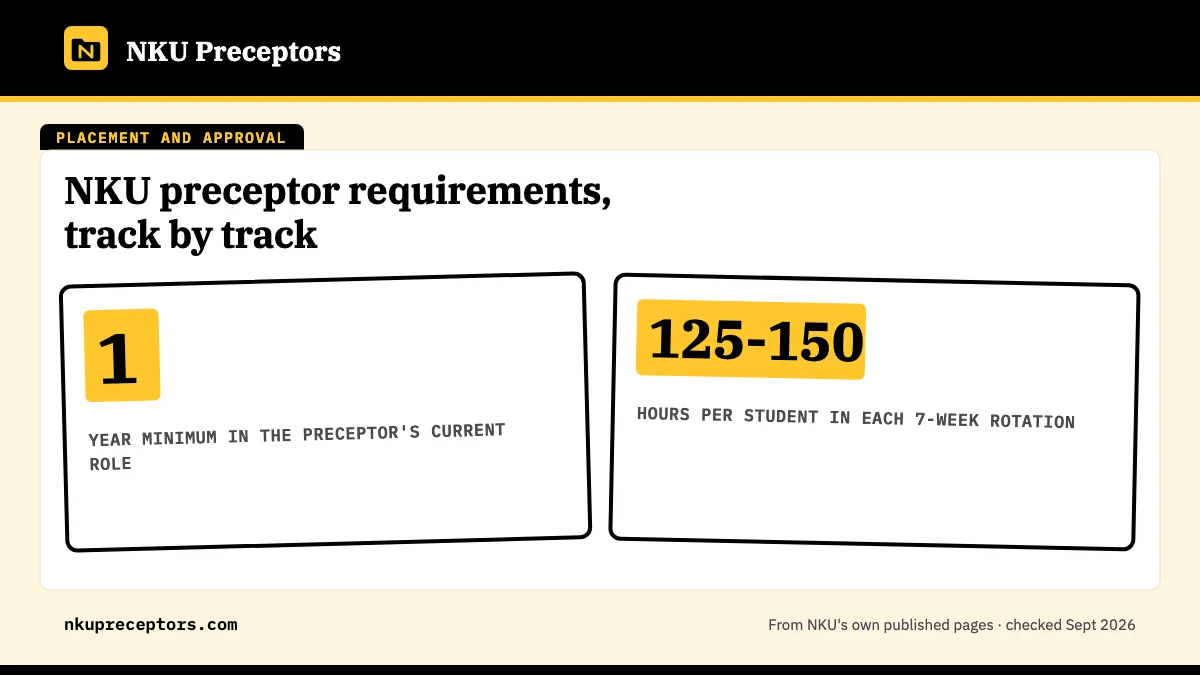
1year minimum in the preceptor's current role
125-150hours per student in each 7-week rotation
NKU preceptor requirements, track by track. 1: year minimum in the preceptor's current role; 125-150: hours per student in each 7-week rotation.
1: year minimum in the preceptor's current role; 125-150: hours per student in each 7-week rotation.

Rules every preceptor meets

NKU's Interested Preceptors page sets a baseline that applies to every graduate track. A preceptor has to satisfy each of these:

  • Experience: at least one year in the current role at the current education level.
  • License: active and unencumbered.
  • Location: within the current NKU-approved states, which NKU lists on its state authorization tables.
  • Employment: employed at the location where the practicum takes place.
  • Capacity: not already at the maximum approved preceptor-to-student ratio, counting students from NKU and elsewhere. NKU does not publish the number.
  • Time: a 7-week commitment of "approximately 125-150 hours per student", with availability two to three days a week.

NKU's online FAQ adds one more floor for every concentration: the preceptor holds a master's degree or higher. Taken together, the two pages give the baseline for every track; the concentration rules below sit on top of it.

Credentials NKU accepts

The Interested Preceptors page lists the credentials NKU accepts across its graduate programs:

  • Nurse practitioners with a master's or doctoral degree in nursing and NP certification in the specialty area.
  • Psychiatric clinical nurse specialists.
  • Board-certified psychiatrists.
  • Certified nurse midwives with a master's or doctoral degree in their area of practice.
  • Physicians, MD or DO.
  • Physician assistants with a master's or doctoral degree, "if allowed as a preceptor by the state."
  • Psychologists or graduate-prepared counselors, LPCCs and LICSWs.
  • Nurse executives.

Not every credential fits every track. The list is a menu; your concentration decides which items on it can supervise your hours. PMHNP students, for example, can spend some therapy hours with a psychologist, LICSW or LPCC, while Nurse Executive Leadership students learn under a nurse leader rather than a prescriber.

Who can precept each track

NKU's FAQ breaks preceptor qualifications down by concentration. This is how the tracks compare.

NKU preceptor qualifications by concentration (NKU Online FAQ)
TrackWho can preceptSettings
FNPMD, NP, PA or DOPrimary care; long-term care and hospice; specialty offices for up to 125 hours
AGACNPMD, AGACNP, FNP, PA or DOAcute care hospitals; ER and urgent care for up to 50% of hours
PMHNPPMHNP or psychiatrist; a psychologist, LICSW or LPCC for therapy experiencesPsych and mental health facilities, outpatient clinics, treatment facilities, inpatient hospital; therapy hours capped at 80
Nursing EducationMaster's or higher in nursing educationA school of nursing or a healthcare facility's education department
Nurse Executive LeadershipAn MSN-prepared nurse leader, nurse manager or aboveA hospital, or another setting the NEL coordinator approves

NKU's four NP certificates run on the matching MSN clinical courses, so plan on the same preceptor rules for them. The caps in the last column are explained on NKU clinical setting rules.

Nursing Education has two kinds of preceptor. The 50 direct-care hours in MSN 614L can be done in settings such as wound care, a clinic, an acute care unit, a midwifery practice, an outpatient or surgery center, or a PACU, while the capstone preceptor for MSN 670 must work as an educator. More on the nurse educator clinicals.

Who is ruled out

Credentials don't override personal ties. NKU bars a clinician from precepting you if they are any of these:

  • Your direct or immediate supervisor.
  • A relative or family member, a fiancĂ© or a significant other.
  • A roommate or a personal friend.
  • Your own primary care provider.
  • A current student in another specialty.

Clinicals at your own employer are allowed, provided the hours are off your own unit, precepted by someone other than your supervisor, and not on the clock. Clinicals where you work has the detail.

If you are unsure whether a connection counts, raise it with your coordinator before the request goes in rather than after a reviewer spots it.

What changed, and what NKU leaves open

A 2022 copy of the Interested Preceptors page described a rotation as approximately 125 hours per student; the live page says 125 to 150. The credential list, the one-year rule, the employment and ratio rules and every restriction are otherwise unchanged since then. The 2022 page also pointed to an older state map, which has since given way to NKU's state authorization page.

Some questions have no public answer. NKU publishes no preceptor-to-student ratio, and it sets no published limit on how many of your hours can come from physicians or PAs. The FAQ still lists AGNP preceptor qualifications even though AGNP is missing from NKU's current program list. For anything unsettled, ask your Clinical or Concentration Coordinator through the MSN Clinical Information Canvas.

How we match preceptors to NKU's rules

Every preceptor we bring you has already been screened against this page. A placement advisor confirms the credential fits your track, the license is active in a state NKU approves, the clinician has a year in the role and is employed by the site that will host you, and no supervisory or personal tie on NKU's list applies.

We also plan around the caps that shape your hours, such as the FNP specialty limit or the PMHNP therapy limit, so each rotation builds toward your total instead of stalling it. You get a preceptor whose file answers the coordinator's questions before they are asked. NKU has the final say; we see to it that the preceptor you name fits its rules going in. Tell us your track.

FAQ

Questions NKU nursing students ask

Can I train with a PA as an NKU FNP or AGACNP student?

Yes, if the state permits it. NKU's FAQ includes PAs on the preceptor lists for both tracks, and the Interested Preceptors page accepts a PA holding a master's or doctorate, subject to state rules on who may precept. Check your state's position first, then hold the PA to NKU's one-year and employment rules like anyone else.

Is an FNP an acceptable preceptor for AGACNP clinicals?

It is on NKU's list. The FAQ's AGACNP entry names MD, AGACNP, FNP, PA and DO preceptors, with rotations in acute care hospitals and up to half of the hours in an ER or urgent care. An FNP who works in an acute care hospital and meets NKU's experience, license and location rules fits that description.

How many NKU students can one preceptor take?

NKU doesn't publish a number. Its rule is that a preceptor can't already be at the maximum approved preceptor-to-student ratio, counting students from NKU and from other schools. If your preceptor already hosts students, raise it early with your Clinical or Concentration Coordinator so the preceptor review in Medatrax holds no surprises.

Can an NP with under a year in practice precept me?

Not yet. NKU's experience rule asks for a full year in the role the preceptor holds now, at their present level of education, so a newly certified NP must first log a year of NP practice. The same NP could precept you in a later session once that year is behind them, provided NKU's other rules are met.

Can a friend or relative precept me if they meet every other rule?

No. NKU's personal-ties rule applies whatever the credentials: family, partners, roommates, friends and the clinician who provides your own primary care are all excluded. So are your direct supervisor and anyone currently enrolled as a student in another specialty. Look instead to clinicians in your professional network who have no such tie to you.

Last checked 2026-09-24

We check these pages against NKU's own published sources. NKU's School of Nursing and your Canvas clinical shells have the final word.

Placement desk

Your NKU preceptor, found and filed early.

Tell us your NKU track, where you live and which 7-week session your clinical starts. We find a preceptor and site that fit NKU's rules for your track and have your self-placement request ready well inside the 90-day window.

  • Built for FNP, AGACNP, PMHNP, Nursing Education, Leadership and DNP students
  • Preceptor CV, license and responsibilities form gathered for Medatrax
  • Near home, in a state NKU approves

Start your placement plan

A placement advisor replies with the preceptor and site that fit NKU's rules for you.

By sending this you agree we may reply by email, call or text about your placement. Message and data rates may apply; reply STOP to opt out. Privacy

Placement deskPlacement Coordinator · online