Clinical placement service for Northern Kentucky University nursing studentsChat with the placement desk
NKU PreceptorsClinical placement for NKU nursing studentsFind my preceptor
Evaluations

How NKU evaluates your clinical work: preceptor, faculty and Clinical Instructor

At the end of each rotation your preceptor completes an evaluation of you in Medatrax. During the rotation, NKU's model has the preceptor meet with you and faculty by video, and a Clinical Instructor oversees each clinical course. NKU publishes no policy on in-person site visits.

Get your placement plan

Tell us your NKU track and where you live. A placement advisor replies with the preceptor and site that fit NKU's rules for you.

By sending this you agree we may reply by email, call or text about your placement. Message and data rates may apply; reply STOP to opt out. Privacy

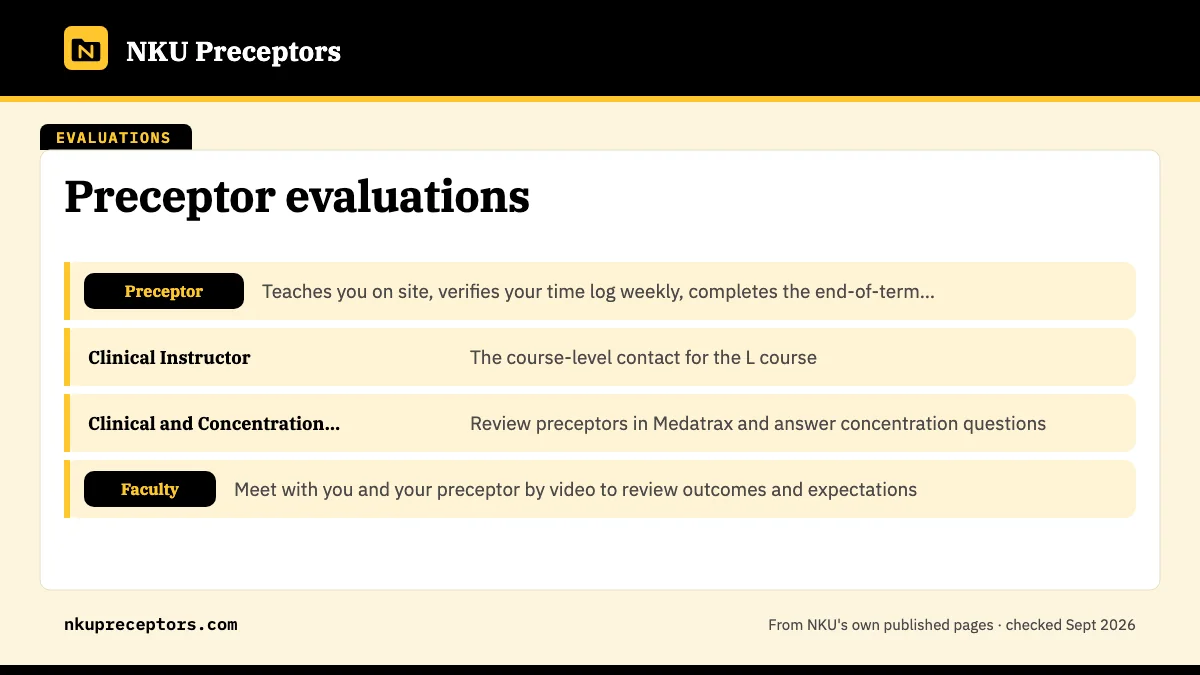
Table. Oversight roles in an NKU clinical course: Preceptor, Teaches you on site, verifies your time log weekly, completes the end-of-term evaluation; Clinical Instructor, The course-level contact for the L course; Clinical and Concentration Coordinators, Review preceptors in Medatrax and answer con
Oversight roles in an NKU clinical course: Preceptor, Teaches you on site, verifies your time log weekly, completes the end-of-term evaluation; Clinical Instructor, The course-level contact for the L course; Clinical and Concentration Coordinators, Review preceptors in Medatrax and answer concentrat

Who oversees a rotation

Three NKU roles and your preceptor share responsibility for each clinical course. Knowing who does what tells you where to take a question and who will judge your work.

Oversight roles in an NKU clinical course
RoleWhat they doWhere to find them
PreceptorTeaches you on site, verifies your time log weekly, completes the end-of-term evaluationYour approved Medatrax placement
Clinical InstructorThe course-level contact for the L coursemyNKU under Class Schedule, and the course Canvas site
Clinical and Concentration CoordinatorsReview preceptors in Medatrax and answer concentration questionsNamed inside the MSN Clinical Information Canvas
FacultyMeet with you and your preceptor by video to review outcomes and expectationsArranged through your course

The Contracts & Compliance team finalizes placements but plays no described part in evaluating your clinical performance.

The end-of-term evaluation

Your preceptor evaluates you in Medatrax at the end of the term. NKU's preceptor readiness checklist lists providing the evaluation forms, in Medatrax, as part of the university's role, and the Current Preceptors page links a Preceptor Evaluation Guide that walks a preceptor through completing it.

The guide is public, so there is no need to wait for week seven to see how the process works. Send it to your preceptor in week one along with the time-log verification guide, and ask them to read it early. A preceptor who knows what they will be asked to rate can give more specific feedback along the way.

The evaluation criteria and how the evaluation counts toward your course grade are set in the course materials. Ask your Clinical Instructor how the preceptor's evaluation is weighed in your L course, and remember that NKU's catalogs require a B or better in MSN nursing courses.

The video meeting with faculty

NKU's 2023 readiness checklist asks each preceptor to agree to meet "face-to-face via technology with the student and faculty." The purpose is to review the course's learning outcomes and expectations with all three people in the same conversation.

NKU does not publish when in the session this meeting happens or how long it runs, so ask your Clinical Instructor at the start of the course. Come prepared with your objectives for the rotation, the hours logged so far, and one or two specific patient types or skills you still need.

NKU's public pages describe no in-person faculty site visits for the online programs. The video meeting is the faculty contact NKU describes, and your preceptor's verification and evaluation in Medatrax carry the rest of the record.

What NKU commits to as the school

The checklist also spells out the university's side of the partnership with a preceptor. NKU provides the course and program objectives, provides the evaluation forms in Medatrax, and lists confirming the preceptor's presence on site, sign-off of activities and prescribing regulations among its own responsibilities.

In practice, your preceptor should be on site for the care you log, and the activities you record should be ones your preceptor has seen and signed off. NKU does not spell out how it checks prescribing regulations; if your rotation involves prescribing decisions, ask your Clinical Instructor what applies in your state.

If any of those pieces seems to be missing during your rotation, raise it with your Clinical Instructor promptly. It is easier to fix supervision in week two than to explain it at evaluation time.

Setting up for a strong evaluation

  • Before day one, exchange contact details with your preceptor, including emergency contacts, as NKU's checklist recommends.
  • Agree on your schedule, your hours and your objectives for the rotation, and share the course objectives NKU provides.
  • Ask for a short orientation to the site, its workflow and its expectations of students.
  • Keep your Medatrax time log verified every week so the evaluation is never delayed by missing hours.
  • Ask for informal feedback at the midpoint, so nothing in the final evaluation is a surprise.
  • Note the date and topic of the faculty video meeting once it is set, and bring your running hour total to it.

The weekly log routine is covered on our hour logs page, and the Medatrax screens themselves on our Medatrax guide.

When a rotation goes off track

Problems rarely fix themselves before evaluation time. If your preceptor is often absent, the patient mix does not fit the course, or feedback is hard to get, tell your Clinical Instructor early and ask what the course allows. Keep a short written note of dates and what happened, so the conversation rests on facts rather than impressions.

If a preceptor withdraws partway through, NKU's FAQ says a replacement can clear in a few days at a contracted site, while a new agreement may not be finished before class starts. Our dropped preceptor guide covers the steps. A strong rotation ends well too: NKU's Preceptor of the Year award takes student nominations until November 1, and our outreach page explains what NKU gives preceptors.

Preceptors ready for NKU's process

The placements we arrange start with clinicians who want to teach and who fit your track and NKU's state rules. Before your first day, a placement advisor briefs the preceptor on what NKU asks of them: the Preceptor Profile, weekly verification, the video meeting with faculty and the end-of-term evaluation in Medatrax.

Their documents and a site contact come to you ready for the self-placement request, so your coordinators review a complete file. NKU approves every preceptor, and the one you submit arrives already prepared for NKU's evaluation process. If a rotation stalls, we find the replacement while you keep your coursework moving. Tell us about your next L course with the form below.

FAQ

Questions NKU nursing students ask

Who evaluates me in an NKU clinical course?

Your preceptor completes an end-of-term evaluation of you in Medatrax, using forms NKU provides. Your Clinical Instructor is the course-level contact, and NKU's model includes a video meeting between you, your preceptor and faculty to review outcomes and expectations. How each piece counts toward your grade is set in the course materials.

When does my preceptor complete the NKU evaluation?

At the end of the term, in Medatrax. NKU posts a Preceptor Evaluation Guide on its Current Preceptors page that shows the steps. Send it to your preceptor at the start of the rotation, and keep your time log verified weekly so hours are settled before the evaluation is due.

Does NKU faculty visit my clinical site in person?

NKU publishes no policy on in-person site visits for its online programs. The faculty contact NKU describes is a meeting by video with you and your preceptor to review learning outcomes and expectations. Ask your Clinical Instructor at the start of the course when that meeting will happen.

What does the Clinical Instructor do during my rotation?

The Clinical Instructor is your course-level contact for each L course, listed in myNKU under Class Schedule and in the course's Canvas site. Take questions about course expectations, hours, supervision problems and evaluation weighting to them. Preceptor approval questions go to your Clinical or Concentration Coordinator instead.

Can I see the NKU preceptor evaluation before my rotation starts?

NKU's Preceptor Evaluation Guide is posted publicly on its Current Preceptors page, so you and your preceptor can read how the process works before day one. The evaluation itself is completed in Medatrax at the end of the term. Your course materials describe what the course expects of you.

Placement desk

Your NKU preceptor, found and filed early.

Tell us your NKU track, where you live and which 7-week session your clinical starts. We find a preceptor and site that fit NKU's rules for your track and have your self-placement request ready well inside the 90-day window.

  • Built for FNP, AGACNP, PMHNP, Nursing Education, Leadership and DNP students
  • Preceptor CV, license and responsibilities form gathered for Medatrax
  • Near home, in a state NKU approves

Start your placement plan

A placement advisor replies with the preceptor and site that fit NKU's rules for you.

By sending this you agree we may reply by email, call or text about your placement. Message and data rates may apply; reply STOP to opt out. Privacy

Placement deskPlacement Coordinator · online