Clinical placement service for Northern Kentucky University nursing studentsChat with the placement desk
NKU PreceptorsClinical placement for NKU nursing studentsFind my preceptor
Post-master's AGACNP

Acute care preceptors for NKU's post-master's AGACNP certificate

NKU's post-master's AGACNP certificate takes an MSN-prepared nurse into acute care practice through 35 credits and five hospital residencies, MSN 659L to MSN 663L, worth 750 hours. Every residency needs a preceptor you secure and a Medatrax request NKU approves. We find hospital preceptors near you and keep each request ahead of the deadline.

Line up your acute care residencies

Share your state, your critical care background and your first residency session. A placement advisor maps hospital preceptors for all five.

By sending this you agree we may reply by email, call or text about your placement. Message and data rates may apply; reply STOP to opt out. Privacy

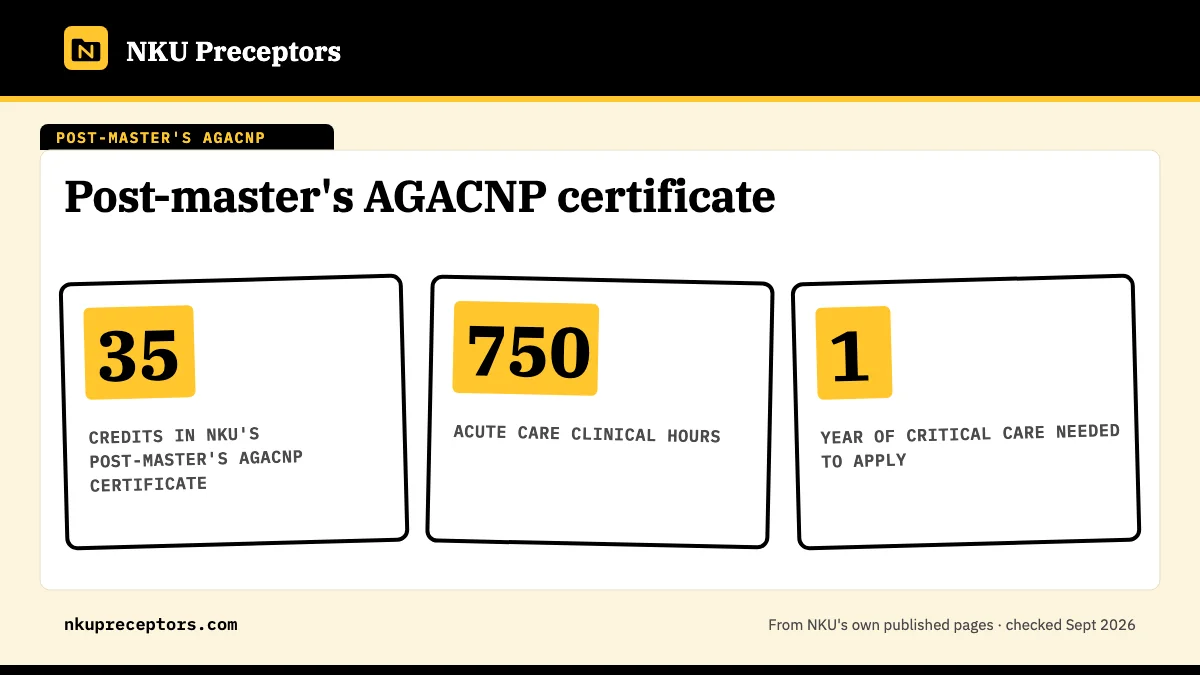
35credits in NKU's post-master's AGACNP certificate
750acute care clinical hours
1year of critical care needed to apply
Post-master's AGACNP certificate. 35: credits in NKU's post-master's AGACNP certificate; 750: acute care clinical hours; 1: year of critical care needed to apply.
35: credits in NKU's post-master's AGACNP certificate; 750: acute care clinical hours; 1: year of critical care needed to apply.

What the certificate covers

The certificate page lists 35 credits and a fastest pace of 20 months. Coursework opens with the advanced practice core, numbered MSN 609 through MSN 612, then moves into the acute care sequence: three differential diagnosis and disease management courses (MSN 624 to 626), MSN 627 for technology and diagnostic reasoning, the MSN 628 seminar and the MSN 633 capstone. Five residencies of 1 credit each carry the 750 hours.

Each residency fills one 7-week session on its own, since NKU schedules a single clinical at a time. NKU's preceptor page pegs a rotation at around 125 to 150 hours and wants preceptors on hand for two or three days in each week.

AGACNP residencies (2024-25 catalog hours and prerequisites)
ResidencyOpens afterHours listed
MSN 659L Clinical IMSN 626 and 627150 direct patient care
MSN 660L Clinical IIMSN 659LNo archived catalog page
MSN 661L Clinical IIIMSN 660L150 across acute care settings
MSN 662L Clinical IVMSN 661L150
MSN 663L Clinical VMSN 662L, with MSN 633 before or alongside150

Four rotations or five

You may run into the number four. NKU's certificates hub has described this option as having "four embedded supervised clinical rotations", and the 2023-24 catalog listed four acute care residencies, MSN 660L to 663L, in a 34-credit certificate. The certificate's own curriculum today lists five courses and 750 hours, so plan and budget time for five.

Older NKU pages also give lower hour totals for acute care, and NKU's online FAQ, never updated on this point, still tells NP students 500 to 600. When documents disagree, the current certificate page and your AGACNP Canvas shell decide; studentclinicalinfo@nku.edu can confirm for your admit term. The hours history page lays the versions side by side.

The critical care entry rule

Beyond the accredited MSN (ACEN, CCNE or CNEA), a 3.0 MSN GPA, a current RN license without restrictions, 1,000 hours of RN practice in clinical settings and a PreCheck background check, this certificate adds one year of critical care experience. The graduate admission page ties it to a verification form.

That background pays off later. The hospital colleagues you worked beside in critical care are a natural first list of preceptor leads. NKU may also review your earlier core syllabi to confirm they covered patients across the lifespan; any that fall short are retaken at NKU before residencies begin. Missing the APEA predictor benchmark in pharmacology adds MSN 680. See the prerequisites page for the core.

Acute care preceptors and caps

Five credentials qualify: MD, DO, AGACNP, FNP or PA, each graduate-prepared and at least a year into practice; PAs qualify only where state rules allow them to precept. The main setting is the acute care hospital, caring for acutely ill adults from adolescence onward. Emergency and urgent care settings can account for no more than half of your hours, and the later residencies center on high-acuity and specialty work.

Your preceptor also needs

  • At least twelve months in their current post at their current level of education
  • Licensure without restrictions, practicing where NKU approves
  • A staff job at the hospital where you train, with room under NKU's student cap
  • No supervisory, family, household or friendship tie to you

At your own hospital, train away from your home unit, precepted by someone outside your reporting line, during hours you aren't paid for. The setting rules cover every cap.

Hospital agreements take time

Every hospital you train in needs an affiliation agreement with NKU. If none exists, you pass NKU a contact at the hospital and NKU handles the negotiation. NKU needs the agreement signed off by both sides before the term, and it cautions that fresh negotiations don't always finish before classes begin.

That is why the 90-day recommendation matters more than the 30-day floor for acute care. NKU's FAQ adds that if a preceptor withdraws, a site already under agreement can clear within days, while one that needs a new agreement may not. Before you commit to a hospital, ask whether it already works with NKU. The affiliation agreements page explains the process.

States and requests

Applications for this certificate come only from the 11 NP admission states: Colorado, Florida, Georgia, Illinois, Indiana, Kentucky, Michigan, Nevada, Ohio, Virginia and West Virginia. The list has applied since Spring 2023, with its three most recent additions arriving by early 2026. Preceptors must sit in an NKU-approved state, and moving mid-certificate can affect your status; see NP admission states.

Medatrax gets one self-placement request per residency. Along with it go the preceptor's resume and license, a signed Preceptor Responsibilities form and a Medatrax Preceptor Profile. The coordinators review the preceptor, the Contracts & Compliance team checks the hospital contract and your PreCheck and Sentry standing, and a Medatrax email confirms approval once all three portions clear. For a Summer 1 2027 residency starting May 10, the 90-day mark lands around February 9, 2027 by our count; NKU posts its actual deadlines in Canvas.

Why AGACNP certificate students choose us

We know hospital placements. A placement advisor searches the hospitals around you for acute care preceptors, checks unit, credential and state, keeps ER time under the 50% line, and starts the affiliation agreement early by getting NKU the right site contact.

Your request lands complete, well before the 90-day mark, with every preceptor document in place. NKU gives the final approval; we make sure nothing in the file slows it down. All five residencies are mapped up front, with a replacement ready if a schedule falls through. Compare the degree route on NKU's MSN AGACNP page, or start with the form on this page.

FAQ

Questions NKU nursing students ask

Do I need ICU experience for NKU's post-master's AGACNP?

Yes: twelve months of critical care, confirmed on NKU's verification form, alongside an accredited MSN with a 3.0 GPA, an RN license in good standing, 1,000 hours of clinical RN work and a PreCheck background check. Check the current admission page for any update before you apply.

How many residencies does the NKU AGACNP certificate have?

Five residencies (659L, 660L, 661L, 662L and 663L) adding up to 750 hours. The certificates hub has described four rotations and the 2023-24 catalog listed four, but the certificate's current curriculum shows five courses. Plan your preceptors, your agreements and your work calendar around five.

Can an FNP precept my acute care residency?

Yes. NKU's FAQ lists FNPs among AGACNP preceptors, together with AGACNPs, MDs, DOs and PAs. The setting has to be acute care, and the FNP needs graduate preparation, a year in the current role, an unrestricted license and a job at that hospital.

Does my critical care year count toward the 750 hours?

No. The year of critical care is an entry requirement, and NKU publishes no clinical-hour reduction for earlier experience. All 750 hours come from the five residencies, logged in Medatrax and verified each week by your preceptors. Your ICU background helps in a different way: it opens doors to hospital preceptors.

How long does NKU's post-master's AGACNP take?

NKU lists as few as 20 months for 35 credits. With one clinical per 7-week session and five residencies, holding that pace depends on each placement clearing NKU's review before its session starts, including any new affiliation agreement. A residency that misses its session moves the finish line.

What if my hospital has no agreement with NKU?

Your part is naming a contact person at the hospital; NKU carries out the negotiation. Because the agreement must be signed before your residency's term and a new one can run long, share that contact as early as you can, ideally well before the 90-day mark.

Last checked 2026-09-24

We check these pages against NKU's own published sources. NKU's School of Nursing and your Canvas clinical shells have the final word.

Placement desk

Your NKU preceptor, found and filed early.

Tell us your NKU track, where you live and which 7-week session your clinical starts. We find a preceptor and site that fit NKU's rules for your track and have your self-placement request ready well inside the 90-day window.

  • Built for FNP, AGACNP, PMHNP, Nursing Education, Leadership and DNP students
  • Preceptor CV, license and responsibilities form gathered for Medatrax
  • Near home, in a state NKU approves

Start your placement plan

A placement advisor replies with the preceptor and site that fit NKU's rules for you.

By sending this you agree we may reply by email, call or text about your placement. Message and data rates may apply; reply STOP to opt out. Privacy

Placement deskPlacement Coordinator · online